

Educational Hub
Warships / Battleships
Ocean Liners / Cruise Ships
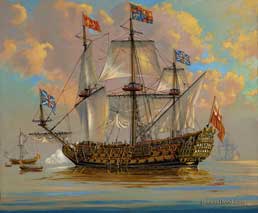
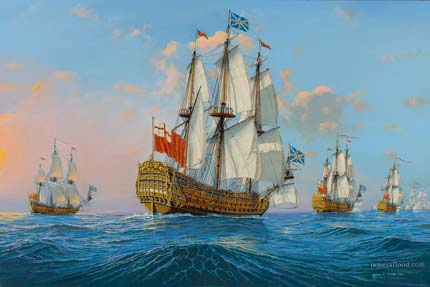
Charles II’s magnificent flagship was a 100 gun 3-decked line of battleship. Built in Chatham, England, and launched in 1682, the Britannia was the biggest ship of Charles II’s 30-ship program. She was originally designed by Sir Phineas Pett with a beam in excess of its specifications by 16” in order to balance a heightened main battery. The Admiralty rejected the increased beam width, although they kept the heightened battery. As a result, it was not until her commissioning several years later, when, loaded with weaponry, it was discovered that she was too top heavy to fight. She was withdrawn from service and returned after being fitted with a girdle of fir that increased her beam width from 47’ 4” to 48’ 8”. Sixteen inches. When she did return to service, in 1692, it was as Lord Russell’s flagship, where she engaged in direct combat with the French prized flagship Soleil-Royal, serving under Conte de Tourville. HMS Britannia in a Gale: Restored HMS Britannia in a Gale: Restored The French were forced to retire, but Tourville was reluctant to abandon his shattered flagship, a decision that slowed down the entire French Fleet. Ultimately the French Fleet divided, half of them striking for the Race of Alderney. The remaining ships in the fleet, under heavy pursuit from the British, were forced ashore where they were destroyed and burnt, including the Soleil-Royal. Not only was the battle a victory for the British, it marked a pivotal point for the French, who would now witness their sea power steadily, slowly, and utterly decline well into the following century. And so it was, that the Britannia, although only seeing action once, would serendipitously land a role that would establish her placement among the Navy’s most famous warships. She remained in service until 1715, when she was broken up and her serviceable timbers used to construct a new Britannia, launched in 1719 and surviving until 1749.
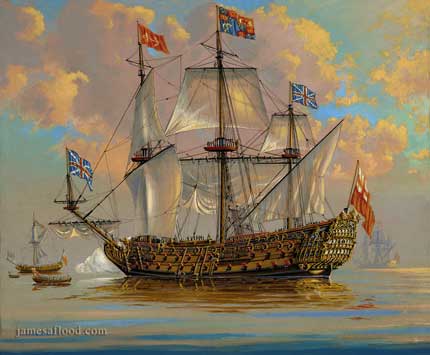
Completed in Portsmouth, England, 1673, during the second Dutch War, the HMS Royal Charles was the second built in a trio of 100-gun first-rate ships designed and constructed by Sir Anthony Deane. Structurally almost identical to the first built of the three 100-gun ships (the HMS Royal James), the Royal Charles was nonetheless strikingly different in her outward appearance. The new ship introduced elegant rows of windows and projecting galleries, even a balcony projecting forward from the quarter-gallery. A look likely inspired from the French fleet, it became a trend that would be carried into the design of future ships. The most dramatic change lay in the design of the figurehead. Gone was the standard single-entity sculpture and in its place was an ornately decorated high relief grouping. It depicted a helmeted warrior charging bravely into battle, his chariot drawn by two racing horses. At his side stood the driver and an armed escort. Intricately carved, baroque in detail, it heralded a new age of art in shipbuilding.
During her first battle, the Royal Charles was plagued by a deep roll that interfered with cannon operations in the lower decks. Ballast adjustment proved unsuccessful, and it wasn’t until the end of the war that girdling, which increased her beam by 1 ft. 4in., resolved the issue of stability. A swift and magnificent vessel, the Royal Charles, in all her incarnations, had a service life that spanned well over a century. Modified in 1693, she was renamed the HMS Queen. Later, in 1715, her salvaged parts were used to build the HMS Royal George, a ship that remained in service until her sinking at Spithead anchorage in 1783. Portrayed as she looked in the 1670’s, the Royal Charles is glorious during her reception of a royal visit.
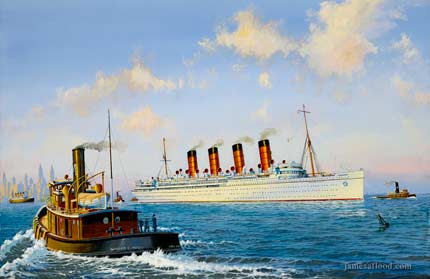
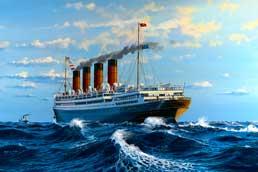
Built by Swan, Hunter & Wigham in Newcastle, England in 1907 for Cunard Line’s Liverpool-New York Service. Reigning as the worlds fastest liner from 1907 to 1929, she was 790 feet long, 88 feet wide, and powered by steam turbines, quadruple screw. More conservative than the Lusitania, Mauretania was still exquisitely decorated. Her Verandah Café, with glazed roof and open air, was surrounded by evergreens and flowering plants, while her first class smoke room was elegant with its walnut, sycamore, and mahogany woodwork. In Cunard’s determination to attract an overall higher level of traveler, great attention had been given to upgrading the second-class accommodations. Here the capacious public rooms were well decorated and the second class smoke room sported handsome mahogany panels.
Commissioned into World War I, she carried more than 10,000 troops through three voyages to the battlefront. It was during one of these passages that she narrowly escaped the fate of her sister, the Lusitania. Due to the rapid response of Captain Daniel Dow and Mauretania’s sharp maneuverability, she was able to dodge an oncoming torpedo and withdraw rapidly from the area. In 1915, her hull painted white, striped green, and funnels buff, she served as a hospital ship. Then, in 1916, painted in camouflage squares and bands of blue and grey, she transported over 6,000 Canadian troops to Halifax. Later, after the United States joined the war, she was to transport thousands of American troops to Europe. In 1934, after a series of mishaps, reconstructions, and bold resurgences, the Mauretania was at last removed from service. In the end, her masts cut down and white hull streaked with rust, she left Southampton surrounded by mournful crowds and headed towards the Firth of Forth, towards the breaker’s yard, where her engines were stopped for the last time, and the scrapping process initialized.
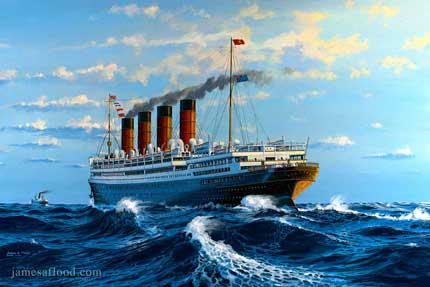
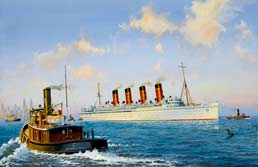
Built by John Brown and Co., Ltd., the RMS Aquitania took her maiden voyage from Liverpool on May 30, 1914. She was 901 feet long and 97 feet wide, with a service speed of 23 knots, and was designed to carry 3,230 passengers. This last four-tunnel liner was ornate in her decor, with design periods ranging from Charles II to Louis XVI. First class staterooms brandished elegant furniture and British art reproductions, while her famous Palladian Lounge displayed a huge eighteenth century Dutch master oil painting on its ceiling. Built for Cunard Line, the RMS Aquitania serviced Southampton- New York. She was commissioned in World War I as an auxiliary cruiser and then as a troopship, carrying over 30,000 troops in a three-month period. She also served as a troopship in World War II, making her the only Cunard ship to serve in both world wars.
When not at war, she resumed her transatlantic services. In the end, she logged over 3 million miles and 1.2 million passengers in her lifetime. Although she was sold for scrap in 1950, the process was not completed until November of 1951. In the painting, this magnificent four-tunnel liner is depicted approaching New York in 1924.
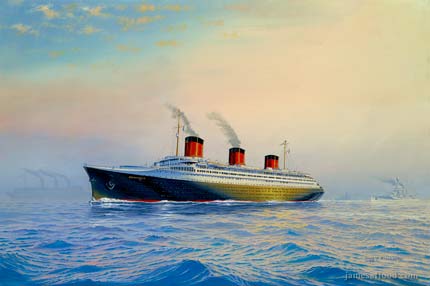
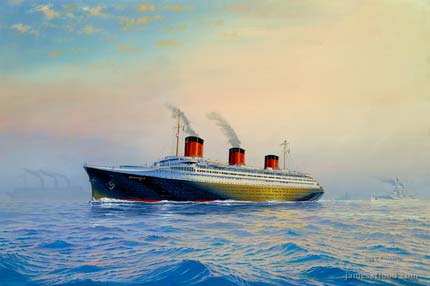
Built by Chantiers d’Atlantique at St. Nazaire, France in 1935, the SS Normandie weighed 82,799 gross tons, was 1028 feet long, 117 feet wide, and designed to transport 1,972 passengers. Her steam turboelectric engines, quadruple screw, were technologically state-of-the-art, running at a service speed of 29 knots, 31 knots reserve. Commissioned for the French Line in May of 1935, her impressive speed immediately earned her the coveted Blue Ribbon. Finances had not been spared in constructing and decorating the Normandie. An unparalleled masterpiece, she was quintessentially French in her artful and opulent décor; a hallmark of post-depression success for France. Her dining room, three decks high, could serve up to one thousand patrons, and was ornately outfitted with hammered glass, Lilique, and bronze fittings. Draped with hand woven tapestries offset by gilded columns, her Grand Salon was a popular meeting place, while her Winter Garden sported live birds. The indoor pool, designed with intricately tessellated mosaic tile, contained 80 feet of graduated levels. Sadly, her legendary days as a super liner were to be short lived. Seized by US authorities in the frenzy of World War II, she was stripped of her valuable décor and renamed the USS Lafayette. Docked at a New York pier, she was to become a casualty of incompetence rather than war. In an embarrassingly unsuccessful endeavor to convert her into a troopship, the vessel first caught on fire, was flooded in a vain attempt to save her, and ultimately capsized. It was February of 1942. She was later salvaged and broken up in 1946-1947.
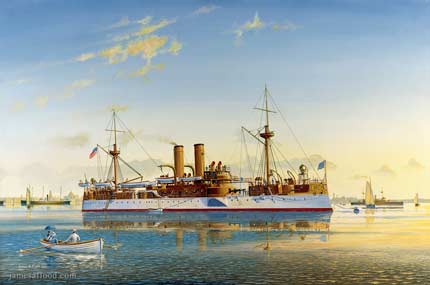
This singularly beautiful second-class armored battleship was commissioned in 1895. She was then signed to the North Atlantic Squadron where she maintained East Coast operations until 1897. Having completed the appropriate training in Key West, she joined the forces developing off the Coast of Cuba, as the struggle between Spain and the revolutionary forces of Cuba heightened. She arrived in Havana on January 25th of 1898. Tragically, on the evening of February 15th, her entire forward part erupted in an explosion which ultimately killed 260 of the 350 aboard. Although she was raised for investigation in 1910, the true cause of the explosion was never resolved to everyone’s satisfaction, and remains a mystery. In 1912 she was sunk with honors and ceremony in the Gulf of Mexico.
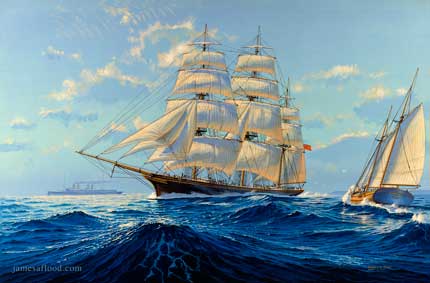
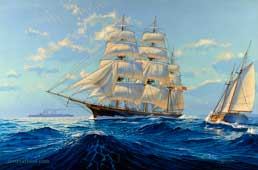
Clipper ships dominated sea trade throughout most of the nineteenth century. Even with the emergence of a newer technology producing the faster and more powerful steam ships, sailing vessels were more economical and continued their popularity well into the twentieth century. So popular were these ships in the bloom of global trade that their classic silhouette has become an international trademark for sea faring transport. Lady Montegue represents the last of these elegant sailing vessels. Her long lines and massive square rigging illustrate the perfect marriage of ship and sea. Merchants and pirates, sailors and immigrants, all sailed on these ships, more than enough material for those wonderful and sometimes lurid tales of romance and adventure at port and sea; tales brought to mind at once by the image of a clipper ship.
In this painting, Lady Montegue is depicted departing the English Channel in the early 1900’s. In the background to the left steams the German ocean liner Kaiser Wilhelm der Grosse, while a classic schooner, Pamela, glides into the channel from the right forefront. Pamela has been out to sea for many months, and, clinging to the ratlines, her captain shouts through his speaking trumpet, hoping to gather some news from the departing Lady Montegue. Note: Lady Montague is one of the artist’s few fictional ships; that is to say, one will find no actual historical record of such a ship. James named her after the wife of the first Earl of Sandwich, Edward Mountagu (an older spelling of the name) (1625 – 1673), a man he came to greatly admire through the writings of Samuel Pepys (1633 – 1703). After coming across a picture of Montegue’s wife, Jemima, and finding her beautiful, he decided that an equally beautiful ship must be her namesake. And thus Lady Montegue came into existence.
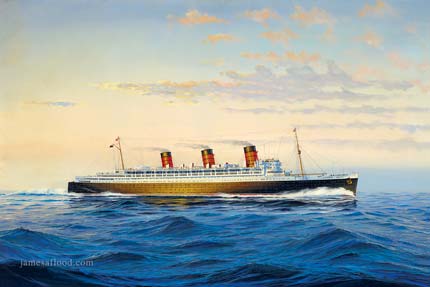
The RMS Queen Mary was built by John Brown & Company, Limited in Clydebank, Scotland, for Cunard-White Star Line. She was 1018 feet long, 118 feet wide, and engined with steam turbines, quadruple screw. She departed from Southampton for her maiden voyage on May 27th, 1936, initiating her Southampton-New York service. Elegantly designed with a broad range of contemporary and classical artwork, yet more conventional than her predecessors, offering the comfort of stuffed chairs and cozy fireplaces, the Queen Mary appealed to the ordinary traveler as well as those preferring a first class passage. This singularly British liner gained popularity rapidly, and came to be cherished in both her homeland and the United States. With the onset of World War II came a change in career for the great passenger liner. On the evening of September 2, 1939, the RMS Queen Mary, mid ocean in a transatlantic voyage, raced her passengers to the safety of New York Harbor. Soon, dressed in wartime gray, she became a troop carrier, able to transport as many as 15,000 troops in one journey. At a maintainable speed of 30 knots, faster than the earliest World War II German torpedoes, she became known as the Grey Ghost. So respected were her capabilities that the enemy placed an outrageous bounty on her. In July of 1947 RMS Queen Mary returned to her peacetime endeavors. Along with a gererous supply of festive post-war tourists, her passenger list sported British royalty, American superstars, and notable statesmen. A close pass to her sister ship, the Queen Elizabeth, became a mid-Atlantic ritual, when, weather permitting, the captains of both ships would intentionally steer within close proximity, saluting each other with three long blasts of their whistles. As air travel increased, passengers on the giant steamship decreased, and the RMS Queen Mary was terminally removed from service in 1967, having transported more than two million passengers, 800,000 troops, and traveled over three million miles. Her last voyage was, however, a grand hurrah. Named the ‘Last Great Cruise’, this 14,559 miles long voyage took her to some of the world’s most exotic ports. Fortunately, the City of Long Beach, California, saved her from an indelicate end by purchasing the stately retiree. She is now permanently berthed in the port of Long Beach, open to visitors as a museum, hotel, and convention center. Ironically, she has welcomed more travelers in her stationary corridors than those she ever encountered on past voyages.
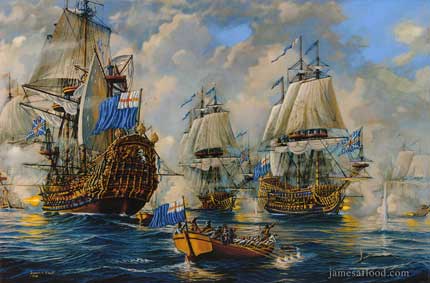
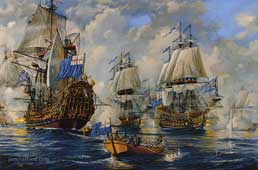
The Battle of Texel during the third Dutch war took place just off the Dutch coast August 21, 1673. The Dutch fleet consisting of approximately 75 ships of the line was under the command of the accomplished Lieutenant-Admiral Michiel de Ruijter. The opposition was an allied fleet of approximately 30 French and 60 British ships and was destined to be one of the brief and unsuccessful alliances between the French and the British. This unfortunate allied fleet was commanded by Prince Rupert, cousin of King Charles II. Under him, the French fleet was led by Vice-Admiral d’Estrées, the British by Sir Edward Spragge. In this battle, the third one that year, the Dutch were strategically positioned just offshore. When the Allied fleet was discovered approaching on August 20, de Ruijter prepared immediately for action. However, the wind was offering the Allied fleet a superior position, and the Dutch sat still, too near shore for the Allies to dare approach.
The following day brought a more favorable wind for the Dutch, and de Ruijter initiated an early and bold attack. On the Dutch side, Dutch Admiral Adriaen Banckert commanded the front, de Ruijter the center, and Dutch Admiral Cornelis Tromp the rear. On the Allied fleet, Rear Admiral de Martel commanded the French in front, Rupert in the center, and Spragge the rear. The Dutch fleet, though outnumbered, had more going for them than the wind and an experienced Admiral. From the onset several factors worked against the Allied fleet. To begin with, communications between the French and the English were severely hampered by an age-old underlying hostility. Sealing this disadvantage was a letter in the possession of the French Admiral d’Estrées. It was from King Louis XIV and requested that the French minimize their involvement to keep their ships from being damaged. Using just a fragment of his fleet, de Ruijter was able to rapidly dispatch the French at the onset. The remainder of the battle concentrated on the British. With the strongest of the Dutch fleet upon them, the situation deteriorated even more for the British when Admiral Spragge took it upon himself, without orders, to hold back the rear in order to engage in direct battle with the Dutch Admiral Tromp, against whom he held a personal vendetta from earlier battles. In this painting, Sir Edward Spragge is depicted being rowed towards the Royal Charles, his intended third change of flagship after the first two had been damaged beyond use during the long summer day battle. All is soon to end for him in moments when a canon ball strikes and everyone onboard the longboat perishes. To note: Spragge was so obsessed with vengeance that he at one time publicly promised the King of England that he would return with Tromp, dead or alive, or forfeit his own life in trying. In his determination, Spragge recklessly held back the rear of the battle line in order to draw Tromp into battle. By doing so, he separated the rear, adding greatly to the confusion, and contributing to the loss of lives. He did, however, keep his word to Charles II, and lost his life in the battle. Shortly thereafter, however, Rupert saved the day by skillfully rejoining the British forces and driving the Dutch into retreat. The historical information above was derived primarily from the book Influence of Sea Power Upon History 1660-1783 by Alfred Thayer Mahan ©1890
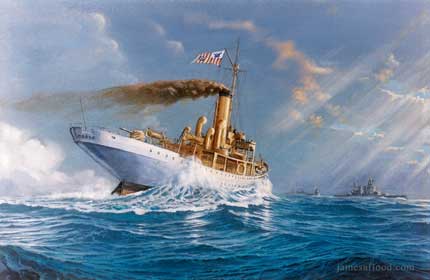
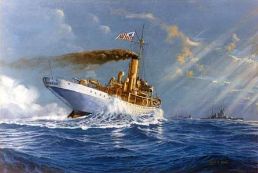
In maritime battle history, much has been written about the interception and sinking of the Bismarck. In a four-day battle sequence riddled with stories of the unexpected, one of the most dramatic is that of the US Coast Guard Cutter Modoc; a small ship caught up in the middle of a very big battle. Fog, mistaken identity, and the providence of a jammed mechanism all play a role in her singular wartime adventure: On May 24th, 1941, the Modoc, whose mission was to patrol allied convoy lanes for survivors of German U-Boat attacks, is heading east in the Denmark Strait, tracking the remains of an eastbound convoy. At twilight, the crew observes a huge gray vessel heading rapidly southbound. It is the Bismarck, recent from battle with the British blockade where she succeeded in sinking the HMS Hood. Damaged from the engagement, she is moving full steam ahead now, her guns trained on the centerline, attempting to outrun or outfight the vengeance-driven British Fleet and escape to the Atlantic.
Overhead, fighter aircraft from the HMS Victorious, in hot pursuit, begin their attack on the Bismarck. In the ensuing exchange, flaming remnants fall all too close to the small cutter, compelling her to rapidly seek an escape route. As the Modoc attempts an exit, her situation becomes even more perilous. The British commanding officers on the pursuing battleships, unaware of the Modoc’s presence, are unable to identify her. Having just lost the Hood and on the lookout for sneak maneuvers from the Germans, any unknown vessel is suspect. Not willing to take any chances, preparations are made to attack. The Prince of Wales takes aim, awaiting the signal to fire. With huge guns pointing directly at her, the Modoc turns towards the protection of a nearby fogbank. Her pounding antiquated steam engines, forcing huge clouds of black smoke through her buff funnel, do little to boost her inherent slowness. But onboard the Prince of Wales, the signal flag acknowledging the order to commence fire jams, delaying the firing of guns. Before the issue is resolved, the Modoc vanishes into the safety of the mist. She survives unscathed and later returns to her patrol, lasting throughout the war.
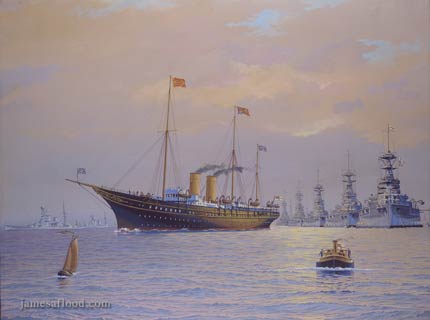
Built in 1899, the Victoria and Albert was not commissioned, however, until the year of Queen Victoria’s death, becoming the official royal yacht of King Edward VII. The splendor of her elegant lines and opulent furnishings provided a regal presence to many royal occasions and regattas across Europe. As the largest and most magnificent royal yacht in Europe, Victoria and Albert III served three monarchs, carrying King George V and Queen Mary at the Jubilee Review of 1935, then, in 1937, King George VI and Queen Elizabeth at the Coronation Review. In 1939, in her senior years, she went into reserve upon the outbreak of war, and was ultimately replaced years later by the royal yacht Britannia. She is depicted in this painting performing her royal duties in the early 1930’s during a review of the British Fleet in the Solent. On her port quarter are Queen Elizabeth class battleships, and on her starboard are anchored the battle cruisers HMS Repulse and HMS Hood.
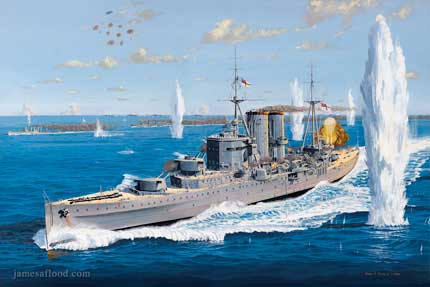
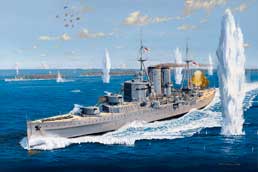
HMS Exeter is portrayed fighting her last battle on 1st March 1942, after being trapped by Japanese forces in the Java Sea. Already justly famous for her part in the December 1939 South Atlantic engagement known as The Battle of the River Plate, which led to the destruction of the German ‘pocket’ battleship Admiral Graf Spee off Montevideo, HMS Exeter was herself cornered and sunk in similar circumstances. On 27th February 1942, she had participated along with American, Australian and Dutch cruisers and destroyers in the confused and strategically flawed engagement known as The Battle of the Java Sea. During that battle, HMS Exeter was hit in ‘B’ Boiler Room by an 8” Japanese shell, which drastically reduced her speed, forcing her to retire to Surabaya to effect emergency repairs. During that same battle the Dutch destroyer Hr Ms Kortenaer and the British destroyers HMS Electra (attempting to protect HMS Exeter) and HMS Jupiter were sunk, while later that same evening the Dutch cruisers Hr Ms Java and Hr Ms De Ruyter were also sunk.
On the evening of 28th February, after completing what basic repairs she could at Surabaya, HMS Exeter, accompanied by the destroyers HMS Encounter and USS Pope, attempted to escape into the Indian Ocean via a circuitous route through the Java Sea, intending to use the Sunda Strait to exit. However, four Japanese heavy cruisers and their accompanying destroyers found her hundreds of miles short of there on the morning of 1st March and a new encounter ensued; a naval battle which is oft now referred to as The Battle off Bawean Island. Initially the allied trio was detected while heading west by a Japanese destroyer which was accompanying two Japanese heavy cruisers. Realizing that her small band was in no condition to fight a prolonged engagement, HMS Exeter turned north hoping to evade. However, within the hour, and with the initial Japanese force in hot pursuit, she ran head on into two more Japanese heavy cruisers and their accompanying destroyers coming in from the northwest! Cornered, she turned back east and a running battle ensued until she was finally overwhelmed by the odds against her. HMS Exeter is depicted here trading salvos with the enemy at the end of that running battle only moments before the fatal hit that knocked out all her electrical power and stopped her dead in the water, leaving her at the enemy’s mercy. Her main 8” gun battery is seen engaging two Japanese heavy cruisers in the far distance starboard aft on the southern horizon (HIJMS Nachi and HIJMS Haguro) while her port torpedoes have just been fired at the other two Japanese heavy cruisers on the northern horizon (HIJMS Myoko and HIJMS Ashigara). USS Pope, who has just come across from off HMS Exeter’s port flank, and HMS Encounter are laying down a protective smoke screen between her and the Japanese destroyers whom they are also engaging with their guns. Out of range, a Japanese spotter plane is not affected by the anti-aircraft fire coming from the allied ships. Unfortunately for HMS Exeter, because of ongoing problems with her main gun rangefinder, she is unable to ensure a high degree of accurate fire on the Japanese cruisers, while they in turn have finally begun to straddle her with numerous accurate shell bursts, many of which erupt in huge plumes some 100 feet high in the nearby waters. Moment’s later one of these 8” shells reportedly strikes HMS Exeter and enters ‘A’ Boiler Room, knocking out all her power. Gun turrets can now no longer train or operate*, and with the fight having suddenly become very one-sided Captain Oliver Gordon orders scuttling measures to be taken, and then finally the dreaded order “Abandon ship!” is given. Shortly after all survivors are off the sinking ship, and as she is listing to port, at least one or more Japanese torpedoes strike HMS Exeter; she defiantly rights herself one last time and then heels over to starboard and goes down in 34 fathoms of water with her white Battle Ensigns still flying. The protecting destroyers were not spared either, with HMS Encounter sinking nearby at almost the same time, while USS Pope is sunk several hours later by aerial attack**. Thus ended HMS Exeter’s gallant final battle and the allied naval defense of Java. Survivors off all three ships, of whom there were many, spent the remainder of the war in Japanese prison camps. *When the wreck of HMS Exeter was discovered and dived for the first time in 2007, her turrets and guns were found at the angle and elevation as depicted in this painting. **In late 2008 the wreck of USS Pope was also located some 60 nautical miles away. Artist’s note: This painting was commissioned by Kevin Denlay, one of the explorers aboard the dive vessel MV Empress which discovered the wrecks of HMS Exeter and HMS Encounter in February 2007 after a prolonged five year search. In 2008 he participated in a memorial service – held over the wreck site aboard the modern Type 23 Duke Class frigate HMS Kent – which included four survivors from HMS Exeter herself to whom Kevin presented the white Royal Navy Ensign that he had ‘flown’ on the wreck on one of his dives. Kevin has also been intimately involved with the artist in the lengthy process of creating and finalizing this depiction of the action. Extensive use was made of his detailed photographic images and video footage gathered while surveying the wreck along with his comprehensive research of the action that included both historical texts and contemporary resources (i.e. various historians and survivors from HMS Exeter) and reference to his collection of period photographs of all the combatants involved. Kevin lives in Australia and is a Fellow International of The Explorers Club (New York). Since 1995 he has been actively involved in the discovery of and/or first dives on numerous other historic shipwrecks in various locations around the world and he dedicates this painting to all the servicemen who ‘fought it out’ in World War ll. Back to Top
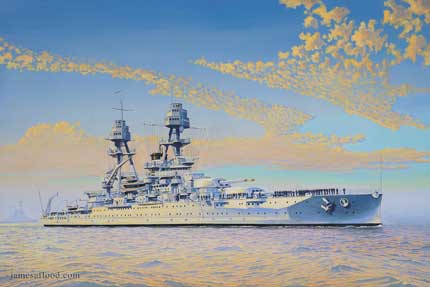
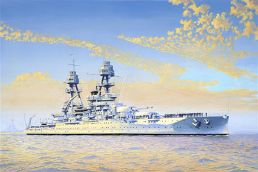
The two ships of the Oklahoma class, USS Nevada and USS Oklahoma, were authorized in 1911 and launched in 1912. The Oklahoma displaced 34,000 tons, with an overall length of 583 feet, and a beam of 107 feet, 11 inches. Her reciprocating engines produced 25,300 horsepower through twin screws driving the ship at 20.5 knots. Her main armament consisted of ten 14-inch .45 caliber rifles and for her second battery; she carried twelve 5-inch .25 caliber anti-aircraft guns. The ship normally carried three scouting seaplanes atop her turrets and quarterdeck catapult, and a crew of 1,301. On the morning of Dec. 7, 1941, at Pearl Harbor, the USS Oklahoma was moored outboard the USS Maryland in a state of complete unreadiness. Most of her watertight manhole covers had been removed, and she was moored in a very exposed position on the east side of Ford Island. She received torpedo hits almost immediately after the attack began and started listing over the starboard side. Ultimately, she was to absorb a total of nine torpedoes. During the war the ship was salvaged in a singularly grand effort, but spent the remainder of the war at quayside, awaiting the decision of what was to be done with her. Probably due to her reciprocating engines, the decision was made not to restore her. Her guns were used as replacements for the battleship USS Pennsylvania and others. After the decision had been made to sell her for scrap, after the 1946 tugs began towing towards the US, towards scrapping, the once proud hulk, five hundred miles out of Pearl Harbor, unaccountably began to list. During one dark, calm night, the USS Oklahoma sank at the end of her towline, rejecting the final indignity of being scrapped.
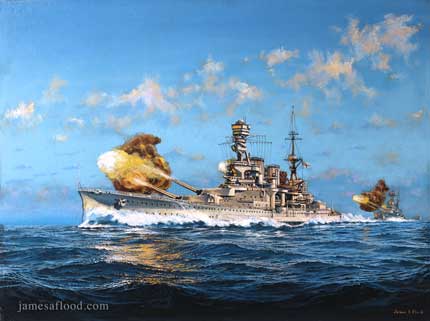
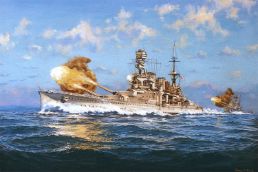
Originally designed in 1914 to be a Royal Sovereign Battleship, the building of the HMS Repulse was halted by the onset of WWI. When building reinitialized later in the year, after the Falkland’s battle, it was determined that she was to be instead a battle cruiser, a much larger vessel than the original design). Built rapidly to meet the expanding war, innovations that might have been implemented in less hurried times were left behind. When Lord Fisher, First Sea Lord of the Admiralty, wanted a ship built, he got it accomplished, to the point of using threats and cajolery. And so it came to pass that in the years following the war, the HMS Repulse, like many of her compatriots, was subject to a substantial number of modifications and retrofits. Her most massive rebuild occurred in the years between 1933 and 1936. The work was accomplished by Portsmouth shipyard and entailed much modernization. The most significant of these changes, at least to the eye, was the removal of the low one-story superstructure aft #2 funnel and its replacement by two story twin aircraft hangers and a fixed cross deck catapult. The bridge and foremast supports were considerably stiffened and refined, giving the overall bridge structure a far more solid appearance. Another dramatic update was the addition of two brand new counter sunk 4 inch AA guns abreast of the mainmast, far superior in every way from the original single barrel, 4-inch gun, a clumsy contraption that was quite slow and very difficult to handle. This painting depicts her first post refit entry into Portsmouth, just following her sea trails, gleaming and spic and span in her fresh paint. Such occasions would bring a considerable number of onlookers. This crowd is obviously quite stuck the stunning elegance of her fierce and majestic symmetry.